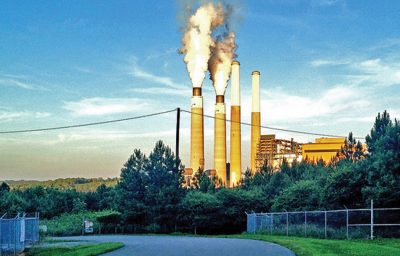
Air Pollution in the Mountains
Campaign For Clean Mountain Air For more information about our efforts to fight proposed coal fired power plants, please visit our Air Pollution website.
What Is a Coal-Fired Power Plant?
A coal-fired power plant refers to any electricity generating facility that burns coal or coal products to heat water to turn a steam-driven turbine. In the United States, there are more than 500 coal-fired power plants currently in operation, and they are all custom designs. However, these designs are all one of three main types of coal power plants:
The most common coal plants are built on a pattern that has existed since the early 20th century, although they make some allowances for modern technology and pollution control devices. These plants, generally called Pulverized Coal plants, burn coal in a boiler to heat water, which then turns a turbine to produce electricity. These plants produce enormous amounts of waste and greenhouse gasses, and achieve only about 37-38% fuel efficiency.
Another kind of coal plant is the Fluidized Bed plant. These plants are not new, having been invented in the 1920s, but are only recently being considered for mass use. These plants can burn coal, biomass, and other fuels including waste coal, trash and tires. Fluidized bed plants suspend fuel on high-pressure jets of air during the combustion process. This allows combustion at relatively low temperatures and higher efficiency, which decreases nitrogen oxide formation. It also allows a sorbent to be injected directly into the combustion process, reducing sulfur dioxide emissions. Fluidized bed plants generally have lower sulfur dioxide and nitrogen oxide emissions, and are more efficient than traditional coal power plants, averaging between 40-50% efficiency. However, both efficiency and pollution control effectiveness are reduced when fuels other than coal are used. This is a problem, since most recent fluidized bed plants have been constructed to burn waste coal, which is on average four times more polluting than normal coal. Also, while fluidized bed plants reduce most emissions, they actually produce more carbon dioxide than a traditional pulverized coal plant.
A relatively new kind of coal power plant is currently being tested. These are called Integrated Gasification Combined Cycle (IGCC) plants. These plants run on a fuel called syngas (short for “synthetic gas”) that can be derived from coal (and almost any other organic material), and is more efficient than unrefined coal. IGCC plants operate by burning syngas to turn a gas turbine and using the heat from this process to heat water, producing steam to turn a steam turbine. IGCC plants are the best environmental use of coal, and are also much more efficient than traditional coal power plants. These plants can achieve 60% fuel efficiency. However, they are much more expensive than pulverized coal plants, and still emit thousands of tons of pollution.
Appalachian Voices wishes to make clear that there is no such thing as clean coal. Although some coal plants emit less pollution than others, all coal plants produce copious amounts of toxic fly ash. Also, no matter how clean a power plant is, all coal must be mined. For more information, please see the Mountaintop Removal section of our website. How Much do Coal Plants Pollute?
On average, a typical coal-fired power plant produces 2,249 lbs of carbon dioxide, 13 lbs of sulfur dioxide, and 6 lbs of nitrogen oxide per megawatt hour. In addition, coal-fired power plants produce traces of mercury and as many as 140 other chemicals classified as “hazardous air pollutants” by the EPA. It must be noted that these pollutants do not disappear from plants with pollution controls. In such cases they are concentrated in the ashe or slag resulting from the combustion process, which is typically dumped without any sort of environmental consideration. Pollutants in the ashe or slag then contaminate local groundwater. The most significant pollutants produced by coal-fired power plants are:
Carbon Dioxide - The most important greenhouse gas responsible for global warming. Carbon dioxide can also cause cause asphyxiation and death in high concentrations - increasingly a concern as energy companies test methods of storing concentrated CO2 underground.
Sulfur dioxide – One of the chemicals responsible for acid rain; responsible for much of the haze that obscures mountain views by as much as 80-90% on summer days; forms “small particles,” which are responsible for at least 23,000 premature deaths every year due to lung disease nationwide, and are increasingly linked to an increase in heart attacks. One study estimated that as many as 4% of cardiac arrest hospitalizations in polluted urban areas are attributable to small particle pollution.
Nitrogen oxide – An increasingly important component of acid rain, nitrogen oxides also interact with sunlight and other molecules to produce ground-level ozone, a lung irritant and major contributor to the current asthma epidemic among America’s children. In addition to posing a major public health concern, ozone damages plants at relatively low concentrations, causing millions of dollars in losses to agriculture and decreasing the health of forests in some of America’s most beautiful landscapes such as the Great Smoky Mountains National Park, Shenandoah National Park, and the Blue Ridge Parkway. Nitrogen oxides also contribute to the haze that obscures those national parks.
Mercury - A dangerous contaminant that builds up in ecosystems, usually passing to humans through consumption of fish. An extremely potent neurotoxin, one tablespoon of mercury is enough to pollute a 20 acre lake beyond acceptable health standards. Mercury poisoning causes tens of thousands of children every year to be born with learning disabilities, neurological disorders and brain damage across the nation. Much of that mercury comes from the burning of coal.
How Much Does a Coal Power Plant Cost?
A traditional coal power plant costs approximately $1,300 per kilowatt hour of generation capacity. Therefore, a 500 megawatt plant costs about $650 million. Integrated Gasification Combined Cycle plants and Fluidized Bed plants are more expensive at more than $1,400 per kilowatt hour, or more than $700 million for a 500 megawatt plant.
All information on this page credited to the National Energy Technology Laboratory and the Energy Information Agency's "Electric Power Annual," which can be found at http://www.eia.doe.gov/cneaf/electricity/epm/epm_sum.html.
|